
What Is the Stroop Effect? The Stroop Experiment Explained

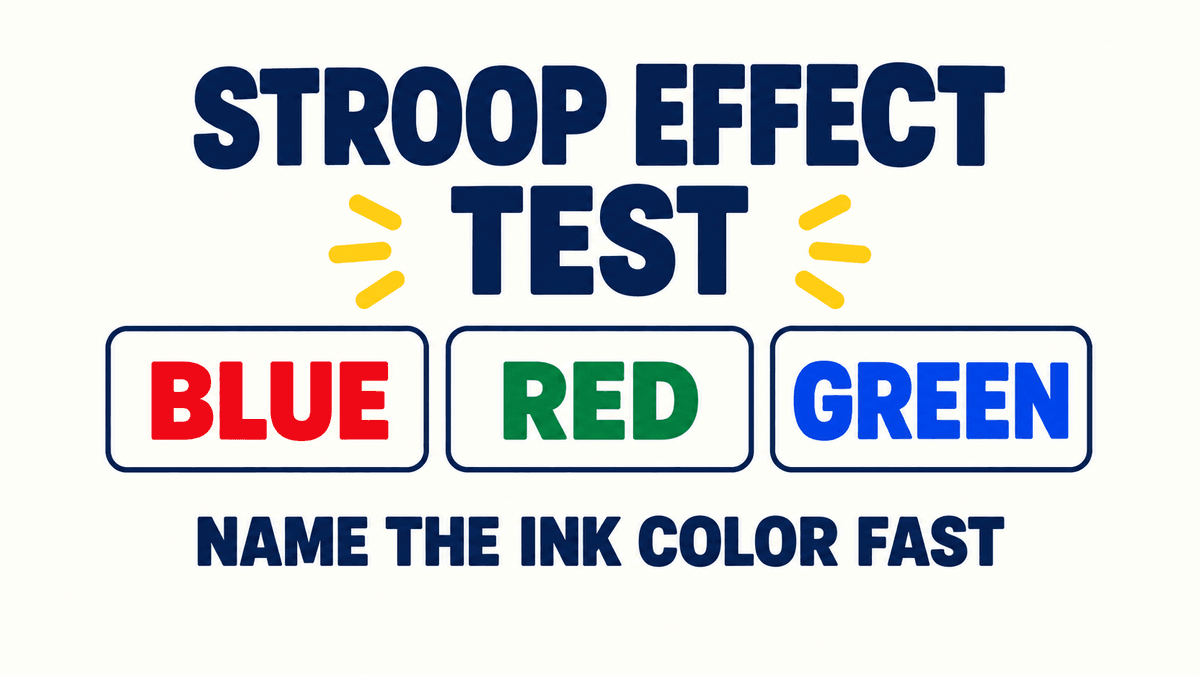
The Stroop effect is the slowdown you feel when a word and its ink color disagree. Naming the ink color of the word BLUE printed in red takes longer, and causes more mistakes, than naming the color of a plain red patch, because reading the word happens automatically and gets in the way.
You can feel it in a minute with our Stroop Effect Test.
The original experiment
In 1935, psychologist John Ridley Stroop published a set of experiments that are still among the most cited in psychology. The key comparison was simple:
- Naming colors: people named the colors of plain patches or symbols.
- Naming ink colors of conflicting words: people named the ink color of color words printed in a different color, such as the word GREEN in blue ink.
The second task was much slower. Reading the words aloud, on the other hand, was barely affected by the ink color. That one-sided interference, where words disrupt color naming but colors hardly disrupt reading, is what we now call the Stroop effect.
Why it happens
For most adults, reading is a heavily practiced, almost automatic skill. Naming a color is something we do far less often and more deliberately. When both point to different answers, the automatic one (the word) has to be held back so the deliberate one (the color) can win.
Researchers describe this in a few overlapping ways:
- Automaticity: the more practiced process intrudes on the less practiced one.
- Selective attention: you have to attend to one feature of the stimulus (its color) and ignore another (its meaning).
- Conflict control: the brain detects that two responses compete and steps up control to settle it. Brain imaging studies link this monitoring to frontal areas, including the anterior cingulate cortex.
A large review of the first half-century of Stroop research found the effect to be remarkably reliable: across many versions and populations, incongruent words reliably slow color naming.
What the test measures
A Stroop test compares two kinds of trials:
| Trial type | Example | Typical result |
|---|---|---|
| Congruent | RED in red ink | Fast, few errors |
| Incongruent | RED in blue ink | Slower, more errors |
The difference between them is the interference cost. It is a simple window into how well you can hold back an automatic response, a skill often described as inhibition or cognitive control. That is why Stroop tasks are widely used in psychology research and are common in neuropsychological testing.
Our online version reports your average reaction time, total time, and the gap between congruent and incongruent trials, so you can see your own interference cost.
Variations
- Emotional Stroop: naming the ink color of emotionally charged words. People often slow down on words related to their own worries.
- Numerical Stroop: judging which digit is physically larger when its value says otherwise.
- Spatial Stroop: words like LEFT or UP placed in a conflicting position.
All of them rely on the same idea: an automatic feature competes with the one you are asked to report.
What it can and cannot tell you
- It shows a skill, not a diagnosis. A slow Stroop score does not mean you have an attention disorder. Fatigue, reading speed, color vision, and device all affect it.
- Practice helps on the task itself. Interference usually shrinks with practice, but does not disappear. Whether that improvement carries over to everyday focus is far less clear.
- Compare yourself with yourself. Your own results over time, on the same device, are more meaningful than one score against someone else.
- Color vision matters. If you have color vision deficiency, a standard color-word Stroop test may not measure what it intends to.
FAQ
What is the Stroop effect in simple terms? It is the slowdown when you name the color of a word that spells a different color. Your brain reads the word automatically, and that gets in the way.
Who discovered the Stroop effect? John Ridley Stroop, in a paper published in 1935.
Does the Stroop test measure intelligence? No. It measures how quickly and accurately you can ignore an automatic response, which is only one small part of thinking.
Can you get better at the Stroop test? Yes, with practice your interference cost usually gets smaller. Try the Stroop Effect Test a few times and compare.
References & Sources
- Stroop, J. R. (1935). Studies of interference in serial verbal reactions. Journal of Experimental Psychology, 18(6), 643–662
- MacLeod, C. M. (1991). Half a century of research on the Stroop effect: An integrative review. Psychological Bulletin, 109(2), 163–203
- Botvinick, M. M., Braver, T. S., Barch, D. M., Carter, C. S., & Cohen, J. D. (2001). Conflict monitoring and cognitive control. Psychological Review, 108(3), 624–652