
Schulte Table Benefits: Evidence, Limits & How to Practice

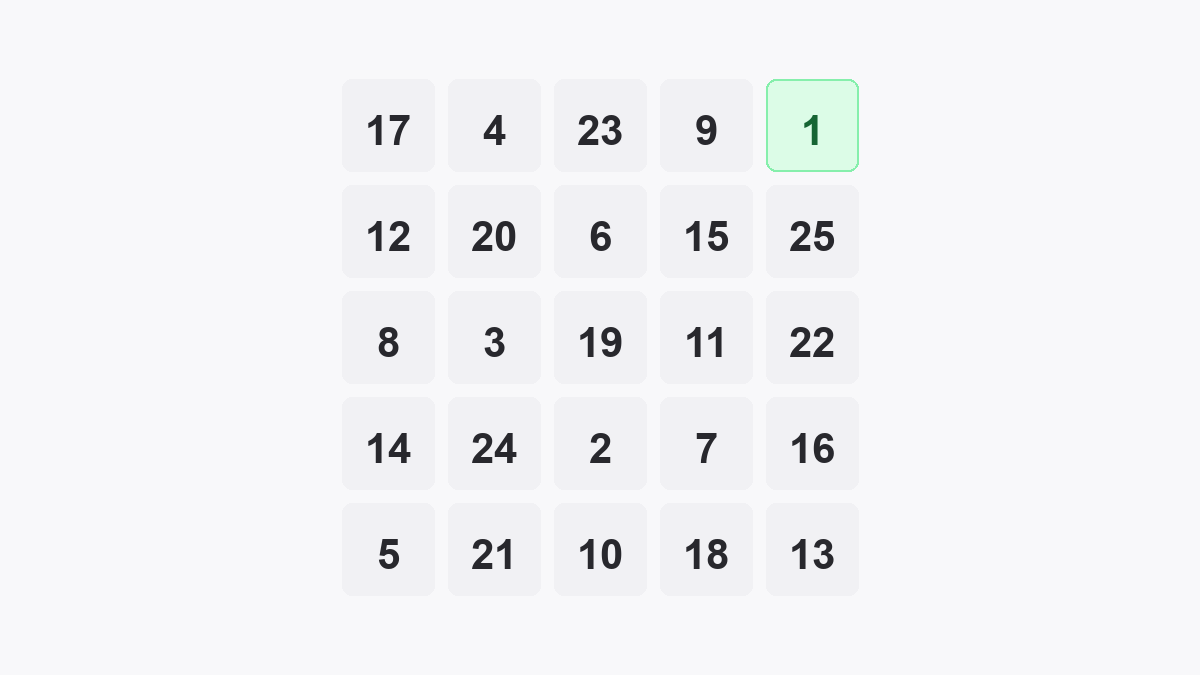
A Schulte Table is primarily a timed visual-search task: you locate numbered targets in order while keeping track of the next target and avoiding mistakes. Research can examine attention and brain activity while people complete this kind of task, and repeated attempts can show whether your performance on the grid changes. The evidence is much weaker for broader claims. A faster grid time does not by itself prove faster reading, better comprehension, treatment of ADHD, or a general cognitive improvement.
🎯 Try the task: Use our free Schulte Table Online to record a personal baseline. Compare later attempts only when the grid size, device, and settings are the same.
This guide separates what the task directly measures from claims that go beyond the available evidence.
What a Schulte Table Directly Measures
In the standard 5×5 version, you find 1 through 25 in order as quickly and accurately as you can. Performance therefore depends on several processes working together:
- Visual search: locating one target among many competing numbers.
- Sequence tracking: remembering which number comes next.
- Goal-directed attention: staying with the task until the sequence is complete.
- Response accuracy: selecting the intended cell instead of a distractor.
- Motor speed: moving and clicking or tapping also contributes to the final time.
A 2021 study measured cortical activity while children and adults completed a Schulte Table task. It helps show that the task can be studied as a combination of cognitive demand and visual search. It does not establish that repeated practice transfers to unrelated abilities or treats a health condition.
What Improvement Means
With repetition, people may become quicker or make fewer mistakes on the same grid format. The safest interpretation is task-specific learning: you are becoming more familiar with the search rules, visual layout, and response method.
| Claim | Evidence boundary |
|---|---|
| A timed grid records completion time and mistakes | Directly measured by the task |
| Repeated attempts can improve Schulte Table performance | Plausible task-specific practice effect |
| Practice reliably improves reading speed or comprehension | Not established by the sources cited here |
| Practice treats ADHD or prevents cognitive decline | Not established; this is not a medical intervention |
This distinction matters because improvement on one structured task does not automatically transfer to complex everyday skills.
Attention Research: Useful Context, Not Proof of Transfer
Posner and Petersen's influential review describes attention in terms of alerting, orienting, and executive-control systems. Those ideas provide useful background for discussing tasks that require sustained readiness, selection of locations, and response control.
However, the review was not a Schulte Table training trial. It should not be used to claim that this game strengthens specific neural networks. A more accurate statement is that completing the task requires attention-related processes; whether repeated practice produces broader or lasting change needs direct intervention evidence.
Peripheral Vision and Search Strategy
Some instructions recommend keeping the gaze near the center and noticing candidate cells away from the point of fixation. You can try this as a search strategy, but the task does not measure the physical size of your visual field. A faster result may also reflect better grid familiarity, a different scanning pattern, faster motor input, or fewer mistakes.
If central fixation feels uncomfortable or makes accuracy worse, use a natural scanning pattern. The goal is a consistent, repeatable task, not forced eye behavior.
Does Schulte Practice Improve Reading Speed?
Reading and number search both involve eye movements, but they are not equivalent tasks. Rayner's review describes fixations, saccades, perceptual span, and the language processes involved in reading. It did not test Schulte Table practice.
Reading comprehension also depends on vocabulary, syntax, prior knowledge, inference, and working memory. For that reason:
- Better Schulte Table times should not be presented as proof of faster reading.
- A visual-search drill cannot replace reading practice with comprehension checks.
- Claims that the task expands usable reading span or reduces regressions need direct evidence from controlled reading outcomes.
If your goal is reading improvement, measure reading speed and comprehension separately rather than inferring them from a grid score.
ADHD, Rehabilitation, and Other Health Claims
A short, structured grid may be an accessible focus activity for some people. That does not make it an ADHD treatment, diagnostic test, rehabilitation protocol, or way to prevent cognitive decline.
Clinical claims require evidence from appropriate patient groups, validated outcomes, comparison conditions, and professional oversight. The Schulte Table on this site is an entertainment and practice tool. It should not replace assessment or care from a qualified professional.
How to Practice and Track a Personal Baseline
There is no universal clinical cutoff for this online game. Uncited labels such as “elite under 15 seconds” or age-based limits should not be treated as population norms.
For a more useful personal comparison:
- Use the same grid size, device, input method, and game settings.
- Record both completion time and mistakes.
- Prioritize accuracy before trying to reduce time.
- Compare several attempts instead of drawing conclusions from one score.
- Stop and rest if you experience eye strain, headache, or discomfort.
The site leaderboard shows results from participating site players. It is not a clinical reference sample and does not indicate diagnosis or cognitive ability.
Summary
The clearest Schulte Table benefit is that it provides a simple, repeatable way to practice and measure performance on a timed visual-search sequence. It can be useful as a brief challenge and personal benchmark. Claims about reading, ADHD, neural strengthening, or broad cognitive improvement require stronger direct evidence than task performance alone.
Related Focus and Attention Games
- Schulte Table Online: A 5×5 number-search task with completion-time and mistake tracking.
- Rotating Schulte Table: A moving-number variation with a different search demand.
- Flanker Test: A flanker-style selective-attention task.
- Dual N-Back: How to Play and What the Research Says: What studies show about working memory training, and where the claims stop.
References & Sources
- Khramova, M. V., et al. (2021). Monitoring the Cortical Activity of Children and Adults during Cognitive Task Completion. Sensors, 21(18), 6021
- Posner, M. I., & Petersen, S. E. (1990). The attention system of the human brain. Annual Review of Neuroscience, 13, 25–42
- Rayner, K. (1998). Eye movements in reading and information processing: 20 years of research. Psychological Bulletin, 124(3), 372–422