
Dual N-Back: How to Play and What the Research Says

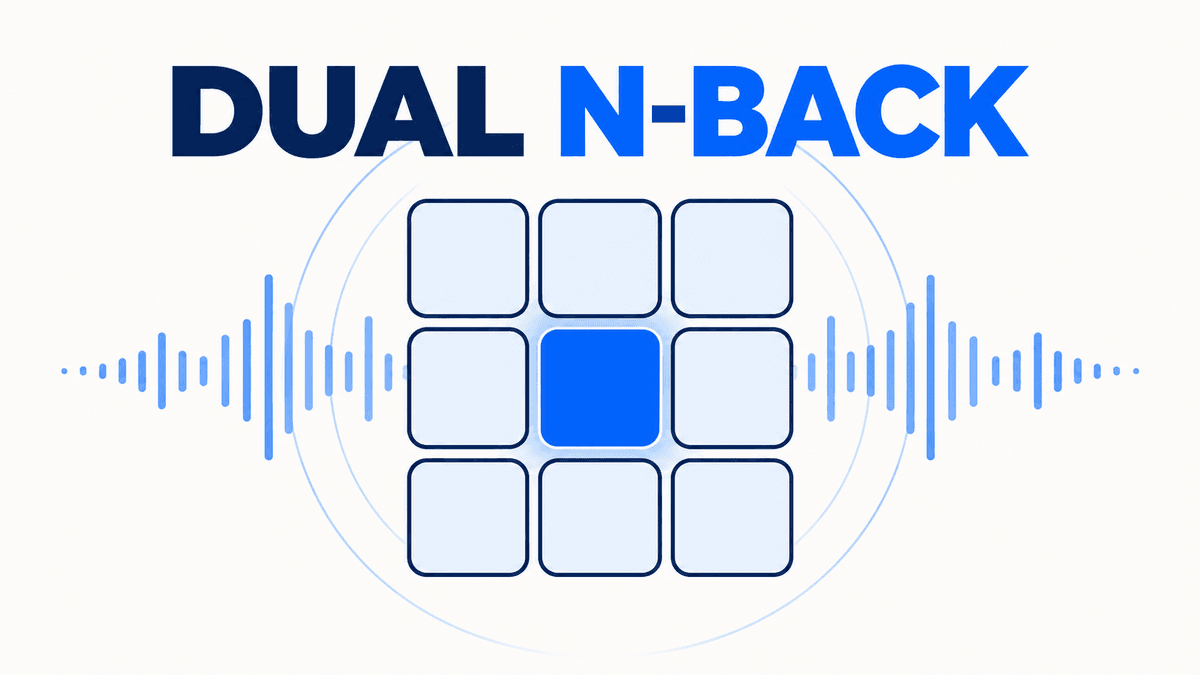
Dual n-back asks you to track two streams at once, a square's position and a spoken letter, and press a button whenever either one matches what you saw or heard N steps earlier. It is a demanding working memory exercise. Research shows people get much better at it with practice; whether that makes you smarter in general is far less certain.
Try it with the 30-second interactive tutorial in our Dual N-Back game.
How the game works
Every 3 seconds, two things happen at the same time:
- a square lights up somewhere on the grid, and
- you hear a letter (C, H, K, L, Q, R, S, or T).
You make two separate decisions on each step:
- Position match: is the square in the same place as N steps ago?
- Audio match: is the letter the same as N steps ago?
If yes, press the matching button. If neither matches, do nothing.
A 1-back walkthrough
In 1-back, you compare each step with the one right before it.
| Step | Square | Letter | What to press |
|---|---|---|---|
| 1 | Top left | C | Nothing yet, there is no previous step |
| 2 | Center | H | Nothing: both changed |
| 3 | Center | K | Position match: the square stayed in the center |
| 4 | Bottom right | K | Audio match: the letter stayed K |
| 5 | Bottom right | K | Both: square and letter repeated |
In 2-back, you compare with the step two places earlier, so you always need to hold the last two steps in mind, and keep updating them as new ones arrive.
When to move up a level
- Start at 1-back until it feels comfortable, roughly 80 to 85% accuracy.
- Move to 2-back next. This is where most people spend a long time.
- Go higher only when the current level is consistently comfortable.
Dropping back a level after a bad round is normal. Steady sessions at the right difficulty work better than forcing a level that is too hard.
How far do players get?
On FreeFocusGames, 576 players have cleared dual n-back at 2-back or higher, meaning a round of at least 20 steps with 80% accuracy or better. Among them:
| Cleared at least | Share of these players |
|---|---|
| 3-back | At least 24% |
| 4-back | At least 11.5% |
| 5-back | At least 4% |
The median accuracy in these clearing rounds was 89%.
Why "at least": our leaderboard keeps only each player's fastest clear, not their highest level. Short 2-back rounds are usually the fastest, so many players who later cleared a higher level are still counted at 2-back here. The real shares are higher than these numbers. Data from April 24 to October 24, 2026; four 10-back records that are very unlikely to be genuine were left out.
For how we collect, filter, and cite all of our player data, see our data methodology.
Common mistakes
- Rehearsing out loud. Saying the letters helps for a moment but tends to fall apart at 2-back and above.
- Focusing on one stream. It is easy to start ignoring the squares while you track the letters, or the other way around.
- Pressing too early. Wait until you have checked both streams before you respond.
- Playing tired. Fatigue shows up quickly on n-back. Shorter, fresher sessions beat long ones.
What the research says
Dual n-back became famous after a 2008 study by Susanne Jaeggi and colleagues. Participants who trained on it improved on a test of fluid intelligence (reasoning with new problems) more than a control group, and the gains grew with more training. The finding drew a lot of attention, because intelligence was thought to be hard to change.
Later work has been more cautious:
- A 2013 meta-analysis of working memory training studies found that people reliably got better at the trained tasks and similar ones, but found no convincing evidence of lasting improvements in broader abilities such as reasoning or reading.
- A 2015 meta-analysis focused on n-back found a small positive effect on fluid intelligence tests, but researchers debated how much of it came from studies with weaker control groups.
- A 2017 meta-analysis of n-back studies found clear improvements on other n-back tasks, and only very small effects on other working memory measures or fluid intelligence.
The honest summary: you will almost certainly get better at dual n-back, and somewhat better at tasks that resemble it. Evidence that it raises intelligence or improves everyday memory is weak and disputed.
How to practice sensibly
- Treat it as a challenging, enjoyable workout for attention and working memory, not a way to raise your IQ.
- Short sessions of 10 to 20 minutes are enough. Consistency matters more than length.
- Track your own level and accuracy over weeks, and keep difficulty where you are succeeding about 80% of the time.
- Mix it with other activities you enjoy. No single exercise is a shortcut.
For other ways to practice, browse all working memory games, or test your span with the Digit Span Test. For lighter options like card matching, see all free memory games.
FAQ
What level of dual n-back is good? Comfortable 2-back is a solid level for most people; 3-back and above take regular practice.
Does dual n-back increase IQ? The evidence is mixed. Early studies suggested it might, but larger reviews found little proof of lasting gains beyond the trained task.
How long should I play each day? 10 to 20 minutes is plenty. Shorter, focused sessions work better than long, tired ones.
What is the difference between single and dual n-back? Single n-back tracks one stream, usually positions or letters. Dual n-back tracks both at once, which makes it much harder.
References & Sources
- Jaeggi, S. M., Buschkuehl, M., Jonides, J., & Perrig, W. J. (2008). Improving fluid intelligence with training on working memory. Proceedings of the National Academy of Sciences, 105(19), 6829–6833
- Melby-Lervåg, M., & Hulme, C. (2013). Is working memory training effective? A meta-analytic review. Developmental Psychology, 49(2), 270–291
- Au, J., Sheehan, E., Tsai, N., Duncan, G. J., Buschkuehl, M., & Jaeggi, S. M. (2015). Improving fluid intelligence with training on working memory: a meta-analysis. Psychonomic Bulletin & Review, 22(2), 366–377
- Soveri, A., Antfolk, J., Karlsson, L., Salo, B., & Laine, M. (2017). Working memory training revisited: A multi-level meta-analysis of n-back training studies. Psychonomic Bulletin & Review, 24(4), 1077–1096