
Digit Span Test Explained: Forward vs Backward and What Your Span Means

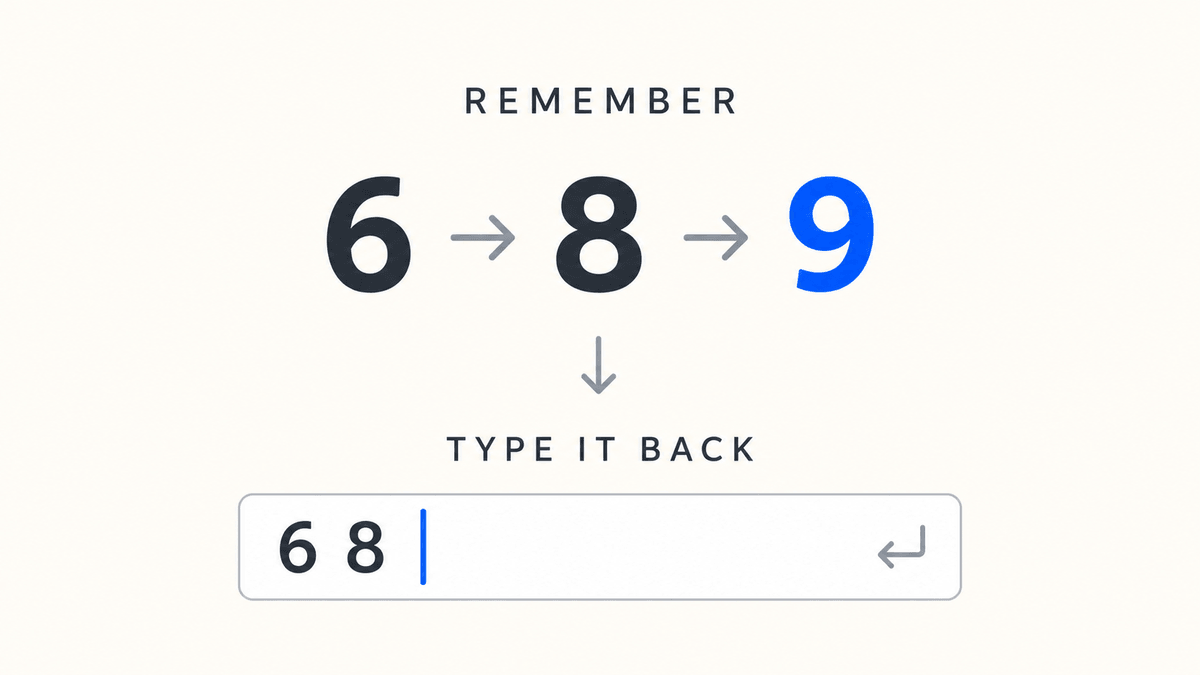
A digit span test shows you a sequence of digits and asks you to repeat it. Your span is the longest sequence you can recall correctly. Forward span mostly reflects how much you can hold for a moment; backward span adds the work of rearranging it, which is why it is usually shorter.
You can find your span in a few minutes with our Digit Span Test.
How the test works
- You see digits one at a time, for example 4 - 9 - 2.
- You type the sequence back: in the same order (forward) or in reverse (backward).
- Each correct answer adds a digit. After two misses at the same length, the test ends.
Your span is the longest length you got right. Digit span tasks have been used in psychology for over a century and are part of widely used clinical test batteries such as the Wechsler intelligence scales.
Forward vs backward
| Version | What you do | Mainly reflects |
|---|---|---|
| Forward | Repeat 5-8-1-6 as 5-8-1-6 | Short-term storage and attention |
| Backward | Repeat 5-8-1-6 as 6-1-8-5 | Storage plus mental manipulation (working memory) |
Backward recall is harder because you have to hold the whole sequence and work through it in reverse at the same time. That extra processing is what makes it a closer measure of working memory.
Why "7" is a famous number
In 1956 psychologist George Miller noticed that people could repeat back about seven items, give or take two, across many kinds of material. "The magical number seven" became one of the best-known ideas in psychology.
Later research refined it. When people cannot group items into familiar chunks, the core capacity looks closer to about four chunks. Digit span often lands near seven partly because digits are easy to group: 4-9-2-7 can become "forty-nine, twenty-seven".
Typical spans on our online test
From the first 214 players of our forward version (October 2026), each with their best result:
| Forward span reached | Share of players |
|---|---|
| 7 or more | 55% |
| 8 or more | 39% |
| 9 or more | 23% |
| 10 or more | 12% |
The median forward span was 7 digits, matching Miller's classic figure. Most players landed between 5 and 9. We don't publish backward results yet because too few players have finished that version.
These are early numbers from a small, self-selected group. Our version also shows digits on screen and lets you type at your own pace, while clinical versions read digits aloud, so the results are not directly comparable.
For how we collect, filter, and cite all of our player data, see our data methodology.
How to get a more accurate result
- Take the test somewhere quiet, without other tabs or notifications.
- Don't write the digits down or say them aloud if you want a fair score.
- Compare forward and backward separately; they measure different things.
- Try it a few times. Your span can shift by a digit from one session to the next.
What it can and cannot tell you
- It is a snapshot. Tiredness, stress, and distraction can lower your span on any given day.
- It is not a diagnosis. A short span alone does not mean there is a memory problem. Clinicians interpret it alongside many other measures.
- Strategies matter. Grouping digits into chunks can raise your span, which shows how much strategy, not just raw capacity, shapes the result.
For what the research says about training working memory, see Dual N-Back: How to Play and What the Research Says, or browse all working memory games. For lighter options like card matching, see all free memory games.
FAQ
What is a good digit span? On our online forward test, 7 is the median; 9 or more puts you in roughly the top quarter.
What is the average digit span? Forward span is usually around 7 digits. Backward span is usually shorter, because reversing the sequence takes extra work.
Is digit span a test of intelligence? It is one part of some intelligence tests, but on its own it measures a narrow skill: holding and manipulating a short sequence.
References & Sources
- Miller, G. A. (1956). The magical number seven, plus or minus two: Some limits on our capacity for processing information. Psychological Review, 63(2), 81–97
- Cowan, N. (2001). The magical number 4 in short-term memory: A reconsideration of mental storage capacity. Behavioral and Brain Sciences, 24(1), 87–114