
Trail Making Test Explained: Parts A and B, What They Measure, and Typical Times

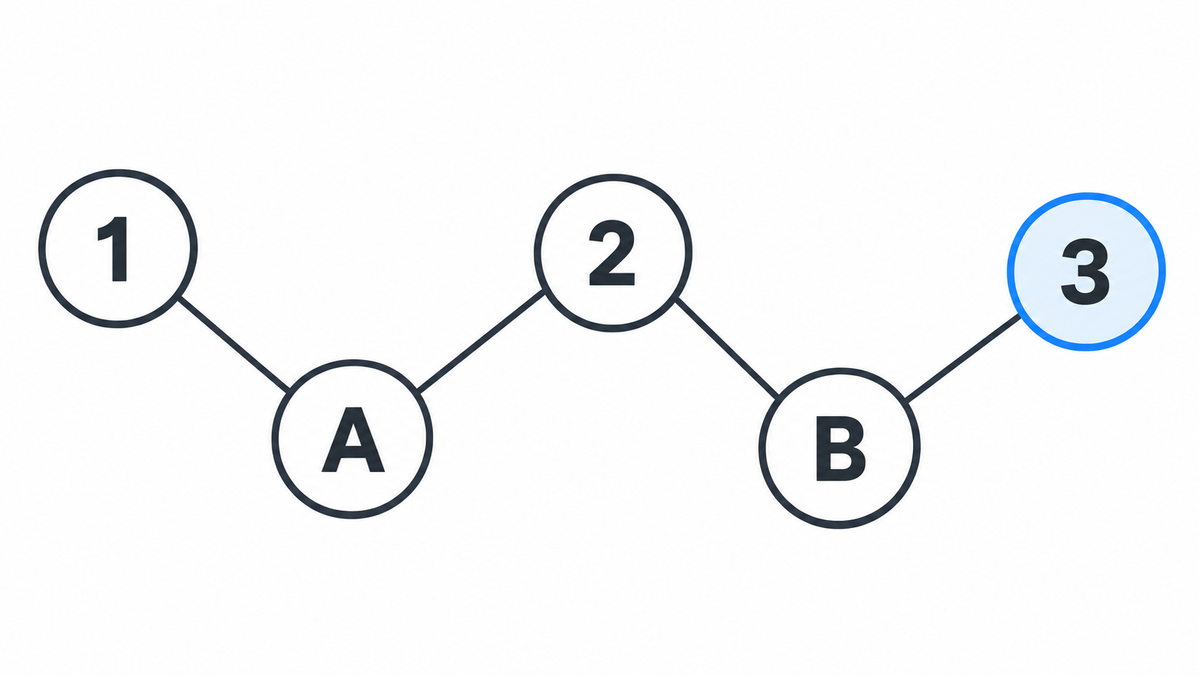
The Trail Making Test asks you to connect circles in order as fast as you can. Part A uses only numbers; Part B alternates numbers and letters (1-A-2-B-3-C…). The extra time Part B takes compared with Part A shows how well you switch between two rules.
You can take both parts in a few minutes with our Trail Making Test.
Where it comes from
The test began as part of a battery of tests used by the US Army in the 1940s. In the 1950s, neuropsychologist Ralph Reitan showed it was sensitive to brain injury, and it became one of the most widely used tests in neuropsychology. It is quick, needs only a pencil and paper, and is still part of many clinical assessments today.
What each part measures
| Part | Task | Mainly reflects |
|---|---|---|
| A | Connect 1 to 25 in order | Visual search and processing speed |
| B | Alternate numbers and letters: 1-A-2-B-3-C… | The same skills, plus switching between two sequences |
Both parts need you to find the next circle and move your hand there. Part B adds one more demand: you have to keep two sequences in mind and switch between them on every step. That switching is often called set-shifting or cognitive flexibility.
How to read your results
Because Part B includes everything Part A does, the most useful numbers compare the two:
- B minus A: the extra seconds Part B took. It removes most of the effect of hand speed and screen size and leaves the cost of switching.
- B divided by A: the same idea as a ratio.
- Errors: connecting the wrong circle, especially in Part B, when you lose track of the alternation.
Typical times on our online test
From the first 201 players who finished both parts (October 2026), each with their best attempt:
| Measure | Median | Middle half of players |
|---|---|---|
| Part A | 34.6 s | 28.8 to 43.0 s |
| Part B | 58.8 s | 47.9 to 78.2 s |
| B minus A | 22.0 s | 14.4 to 36.0 s |
| B divided by A | 1.7 | 1.4 to 2.0 |
Part B took about 1.7 times as long as Part A for the typical player, and 72% of players made at least one error in Part B, against a median of zero errors in Part A.
These are early numbers from a small, self-selected group, so treat them as a rough guide. They also are not comparable with clinical norms: our version is played with a mouse or finger on a screen with randomly placed circles, while clinical norms come from the standard paper forms under controlled conditions.
For how we collect, filter, and cite all of our player data, see our data methodology.
What it can and cannot tell you
- It is not a diagnosis. Clinicians interpret the test alongside age, education, history, and other tests. An online score on its own cannot tell you whether anything is wrong.
- Many things affect your time. Your device, screen size, whether you use a mouse or a touchscreen, and how tired or distracted you are all change the result.
- Practice makes you faster. Repeating the test usually improves your times, which is one reason clinical testing uses it sparingly. For your own tracking, compare attempts under the same conditions.
Tips for a cleaner result
- Do the short practice for each part first.
- Use the same device each time.
- In Part B, say the sequence quietly to yourself: "1, A, 2, B…". It helps you keep track.
- Accuracy first. A wrong connection costs more time than a careful pace.
FAQ
What is a normal time for the Trail Making Test? On our online version, the typical player finished Part A in about 35 seconds and Part B in about 59 seconds. Clinical paper versions use their own age- and education-based norms.
Why is Part B so much harder? Because you have to switch between numbers and letters on every step, and keep track of where you are in both sequences.
What does a large B minus A difference mean? That switching between the two sequences cost you a lot of extra time compared with simply searching for the next number. Tiredness and distraction can make it larger.
References & Sources
- Reitan, R. M. (1958). Validity of the Trail Making Test as an indicator of organic brain damage. Perceptual and Motor Skills, 8(3), 271–276
- Tombaugh, T. N. (2004). Trail Making Test A and B: Normative data stratified by age and education. Archives of Clinical Neuropsychology, 19(2), 203–214